Apartheid and Human Rights Activists.

Apartheid was a system of legal racial separation which dominated the Republic of South Africa from 1948 until 1993, However, the mechanisms of apartheid were set in place long before 1948, and South Africa continues to deal with the repercussions. Under apartheid, various races were separated into different regions, and discrimination against people of color was not only acceptable, but legally entrenched, with whites having priority housing, jobs, education, and political power. Although South Africa was heavily criticized for the system, it was not until 1991 that the legal system of apartheid began to be broken down, and in 1993 was thrown out altogether with the election of Nelson Mandela, the first black democratically elected President of South Africa.
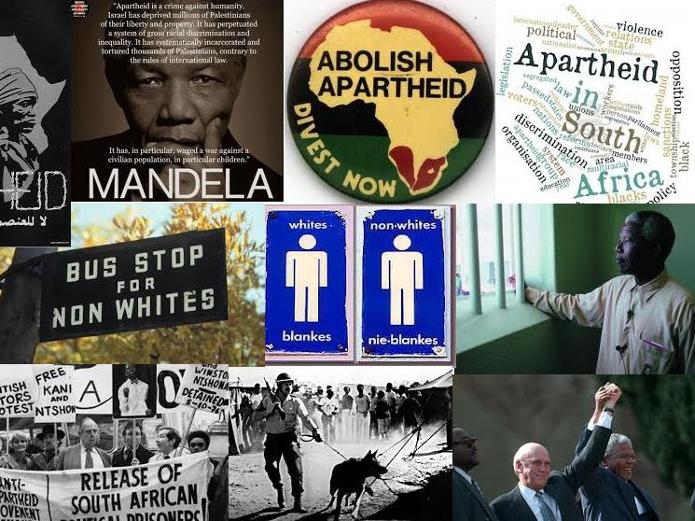
                                                                             South African students discuss Apartheid. 

Introduction: Apartheid, Nelson Mandela, Human right activists. Lesson Identified: 7th Grade Social Studies: A Virtual outline of a week-long lessons unit: The lessons for five days will be a look at the history of Apartheid in South Africa, what Apartheid is and discuss all the evils of Apartheid which include racial segregation, seizure of land, human rights, Colonialism, conflicts, and many more. Look at the role played by Nelson Mandela, freedom and other human right activists. 

Describe Apartheid, the way you understand it?

What factors contribute to Apartheid?

Explain the role played by Nelson Mandela during Apartheid?

How did Apartheid affect the education system in South Africa?

What is freedom, describe?

Describe any other human activist you know?

What role was played by Martin Luther King during the Human Rights movement?

Make a list of five Bill of Rights?

What is an amendment?

Describe the meaning of one Bill of Right of your own choice?


SA Direct (Apr 11, 2009) The Apartheid Museum, South Africa Johannesburg: South Africa. YouTube http://www.youtube.com/watch?v=ASsuKKvvHXI 

Social Studies, Content Standards: Relevant state standard for the grade 7th level.

These content standards are from: http://www.corestandards.org/ELA-Literacy/W/7/2

By the end of the year, read and comprehend literature [informational texts, history/social studies texts, science/technical texts] in the grades 6–8 text complexity band proficiently, with scaffolding as needed at the high end of the range.

Write informative/explanatory texts to examine a topic and convey ideas, concepts, and information through the selection, organization, and analysis of relevant content.

CCSS.ELA-Literacy.RST.6-8.8 Distinguish among facts, reasoned judgment based on research findings, and speculation in a text.

CCSS.ELA-Literacy.RST.6-8.9 Compare and contrast the information gained from experiments, simulations, video, or multimedia sources with that gained from reading a text on the same topic. 

 Communication and Collaboration

Students use digital media and environments to communicate and work collaboratively, including at a distance, to support individual learning and contribute to the learning of others. Students:

1.     Interact, collaborate, and publish with peers, experts, or others employing a variety of digital environments and media.

2.     Communicate information and ideas effectively to multiple audiences using a variety of media and formats.

3.     Develop cultural understanding and global awareness by engaging with learners of other cultures.

4.     Contribute to project teams to produce original works or solve problems.

References:

http://www.globaled.org/guidelines/whatstudy.html#one

http://www.marylandpublicschools.org/MSDE/programs/ccss

http://mdk12.org/instruction/curriculum/social_studies/standard6/grade7.html